
Teeth Whitening
A brighter shade for your smile…
Tooth colour may vary naturally from person to person and can change with age and habits such as drinking tea or coffee or using tobacco.
Teeth whitening is a treatment that aims to lighten the natural colour of teeth when appropriate.
Treatment can take place at the dental clinic, at home under a dentist’s guidance, or through a combination of both.
When choosing a method, your dentist considers the cause of the discolouration, your oral health, any existing fillings or crowns, and your expectations.
The treatment process, the degree of whitening, and how long the results last can vary from person to person.
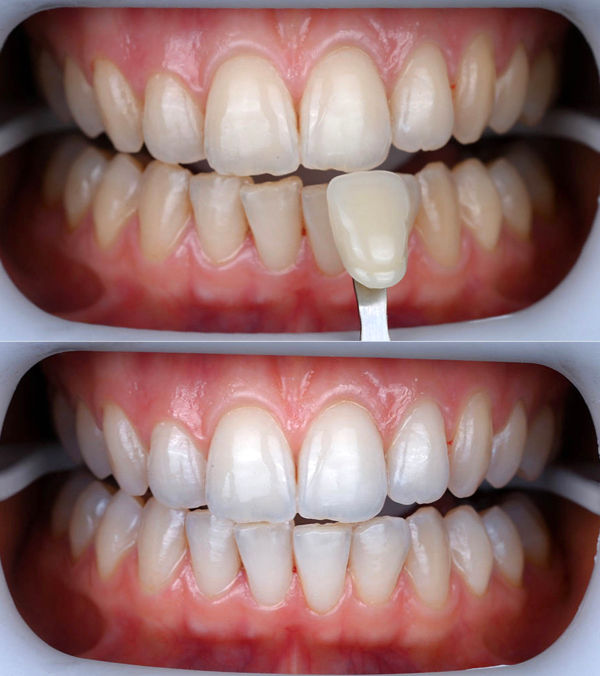
In-Office Whitening
Also known as clinic whitening, it is carried out by the dentist in the clinic.
After the gums are covered with a protective barrier gel, a high-concentration whitening gel containing hydrogen peroxide is applied to the front surfaces of the teeth. The gel is renewed at intervals during the session.
The procedure is usually completed in a single session of about one hour; the session may be repeated if needed.
-
The change in colour can be seen within a short time.
-
The entire procedure is carried out under the dentist’s supervision.
-
It may be preferred when time is limited.


At-Home Whitening
After an analog or digital impression is taken, thin, clear trays are custom-made.
A low-concentration whitening gel containing carbamide peroxide, provided by the dentist, is placed in the trays.
The trays are worn for the recommended time, usually a few hours a day or overnight.
The programme usually lasts 7–10 days and is followed up with check-ups.
-
The change in colour progresses gradually.
-
The treatment fits into daily life.
-
The trays can be kept and used for short top-up treatments in the future.
In some cases, a combined method may also be preferred, in which whitening is started in the clinic and continued at home with the trays.


Frequently Asked Questions
Tooth whitening is a treatment in which various whitening gels are used to lighten the natural colour of the teeth. First, the cause of the discolouration and oral health are assessed. Whitening can then be carried out in the clinic by professionals, at home under the dentist's guidance, or as a combination of both methods.
The main difference between at-home and in-office whitening is the concentration of the whitening gel and the application time. In at-home whitening, a lower-concentration gel is generally applied by the patient at home over a longer period (7–10 nights), using custom-made trays. In in-office whitening, a higher-concentration gel is applied in the clinic by the dentist over a shorter time (about one hour), with the gums protected. The choice depends on the type of discolouration and each person’s needs.
The duration depends on the whitening method. In-office whitening is usually completed in a single session of about one hour, while at-home whitening mostly takes 7–10 nights, with the trays preferably worn overnight. The duration may vary according to the product used, the starting shade and how the teeth respond. The same number of sessions or length of treatment is not suitable for every patient. In some cases, an additional session in the clinic or a longer period of use at home may be needed.
Whitening carried out in suitable patients, with the right products and under the supervision of a dentist, is generally considered safe. However, temporary sensitivity and gum irritation may occur. Uncontrolled use of products or exceeding the recommended application time can damage the teeth and the surrounding tissues.
Although it is difficult to give an exact duration for the effect of whitening, the colour may darken somewhat over time. This varies from person to person, depending on staining factors such as tea, coffee, red wine and smoking, and on oral hygiene. Regular oral care helps maintain the colour of the teeth. If needed, short top-up treatments can be carried out with the at-home trays.
Temporary sensitivity may occur during or after treatment. This usually resolves on its own within a few days. Sensitivity is most often felt with hot and cold food and drinks. If needed, a desensitising toothpaste or gel is recommended; with at-home whitening, the time the trays are worn can be shortened or treatment can be paused. Marked or prolonged pain, or pain concentrated in a single tooth, should be reported to the dentist.
Suitability is determined after an examination. Any untreated decay, gum disease or exposed root surfaces are treated first. Whitening is postponed during pregnancy and breastfeeding, and is generally not recommended for people under 18. For people with marked tooth sensitivity, the method is planned accordingly.
Regular brushing and cleaning between the teeth should be continued, and the dentist’s treatment-specific advice should be followed. With the at-home method, the recommended amount of gel and the time the trays are worn should not be exceeded. If sensitivity or gum irritation develops, a dentist should be consulted before continuing.
Recent clinical studies show that consuming coloured food and drinks after whitening does not make a significant difference to the final shade. However, this does not mean that coloured foods will not contribute to staining in the long term. Rather than a strict rule such as “whitening will be reversed if they are consumed in the first 72 hours”, it is more appropriate to give advice based on the method used and any sensitivity.
Whitening is effective only on natural teeth; it does not lighten the colour of fillings, crowns or veneers. For this reason, if there are existing restorations, particularly on the front teeth, a colour difference may appear between them and the natural teeth after treatment. Colour matching is considered when the treatment is planned.
No; how teeth respond to whitening varies from person to person. Yellow and brown shades generally respond better. With grey shades, for example discolouration caused by certain antibiotics taken in childhood, the result may be more limited and a longer treatment may be needed. Where whitening is not sufficient, other aesthetic options are considered.
Yes; a darkened root-canal-treated tooth can be lightened with internal (intracoronal) bleaching. In this method, the whitening agent is placed inside the tooth and renewed over several appointments if needed. A sound root canal filling is a prerequisite for this treatment.
Laser whitening is one form of in-office whitening; it is the gel applied to the teeth that whitens them. Some systems use light or a laser together with the gel. Scientific studies show that the use of light does not make a significant contribution to the result.
Whitening toothpastes mostly reduce surface stains; they do not significantly change the teeth’s own colour. Over-the-counter whitening products used without a dentist’s supervision can irritate the gums because the trays do not fit the teeth properly. Methods such as activated charcoal, baking soda or lemon can erode the enamel and, over time, make the teeth look more yellow.